The Legend of Zelda: Majora's Mask
| a game by | Nintendo |
| Genre: | Action |
| Platform: |
 Nintendo 64 Nintendo 64
|
| Editor Rating: | 8.2/10, based on 9 reviews, 12 reviews are shown |
| User Rating: | 7.0/10 - 48 votes |
| Rate this game: | |
| Updated: | Aug 17, 2026 |
| See also: | Old School Games, The Legend of Zelda Series, Zelda Games, 3Ds Zelda Games |
 Downloads
What's the deal?
At first gander, Link's second N64 adventure may look like a sidestory to Ocarina of Time, but trust us--Majora's Mask is anything but the same same First, there's the oddball plot, which has Link zipping backward in time again and again (thanks to his trusty Ocarina) to save the world from a falling moon. Then there's the three masks that transform Link into creatures with all-new powers, which you must use to make it through the puzzle-packed dungeons. And let's not forget the 20 regular masks that augment your regular abilities.
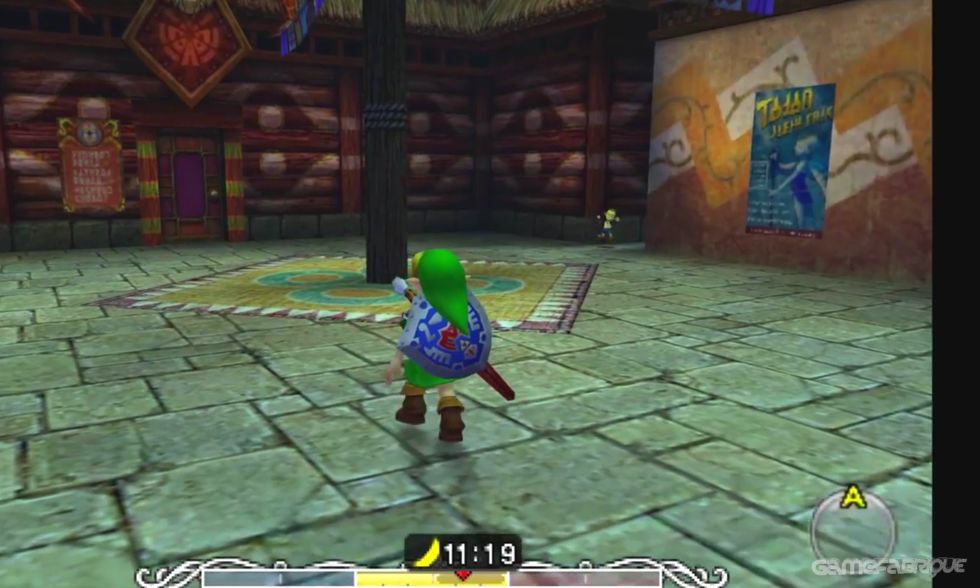
You'll also face all-new bosses, fight new monsters, and abuse new flocks of chickens. And Link's not in Hyrule anymore, either; the game's set in an alternate dimension, so get ready for that same sense of discovery you felt whenever you reached a new area in Ocarina of Time. Better still, all the good stuff from the last game returns in this sequel. You'll find Link's horse, Epona; the same intuitive control scheme; the stunning visuals (the game uses the RAM Pak now, too). You'll even hear classic Legend of Zelda tunes that didn't make it into Ocarina of Time.
So why is it a must-get game?
Look, you know you're gonna buy this game, and we know you're gonna buy this game. But bear in mind it hits stores Oct. 26--the same day as the PlayStation2. All we can say is make sure you get plenty of rest the week before.
Download The Legend of Zelda: Majora's Mask
System requirements:
- PC compatible
- Operating systems: Windows 10/Windows 8/Windows 7/2000/Vista/WinXP
Game Reviews
It's fair to say that we found ourselves with something of a dilemma. Having gained possession of an import copy of the Japanese version of the hotly anticipated sequel to Legend Of Zelda: The Ocarina Of Time - namely Legend Of Zelda: Majora's Mask - we had a serious decision to make. We could in theory have reviewed the game from this version, thereby being the first magazine in the UK with a review and thus guaranteeing huge sales and lots of smiling shopkeepers. However, upon playing the game we soon realised that there was no way we could fairly rate this title in its current form. While the graphics are not going to change and ourselves with something of a dilemma. Having gained possession of an import copy of the Japanese version of the hotly anticipated sequel to Legend Of Zelda: The Ocarina Of Time - namely Legend Of Zelda: Majora's Mask - we had a serious decision to make. We could in theory have reviewed the game from this version, thereby being the first magazine in the UK with a review and thus guaranteeing huge sales and lots of smiling shopkeepers. However, upon playing the game we soon realised that there was no way we could fairly rate this title in its current form. While the graphics are not going to change and the gameplay will remain pretty much the same for the UK translation, the elements that made the first Zelda game such a joy were the storyline, the minigames and the interaction with the myriad of characters. If you're playing the game in a language you don't understand, then you lose all this. We did toy with the idea of getting someone who could read Japanese to review it but since (as far as we're aware) the majority of you lot aren't fluent in the language it seemed a little pointless. So what we thought we'd do instead would be to bring you a massive feature on the game including our impressions, some of the secrets and our hopes for the UK version. And here it is...

The first thing that you notice about Zelda: Majora's Mask is that it looks very similar to the original title (well okay, the first thing you notice is that it's in Japanese - but the similarity thing is definitely next on the list!) This means that if you're expecting some fantastically improved graphics and sound then you're going to be in for a bit of a disappointment. However, since the first Zelda game was none too shabby in the visual and audio departments, this one is looking pretty darn groovy.
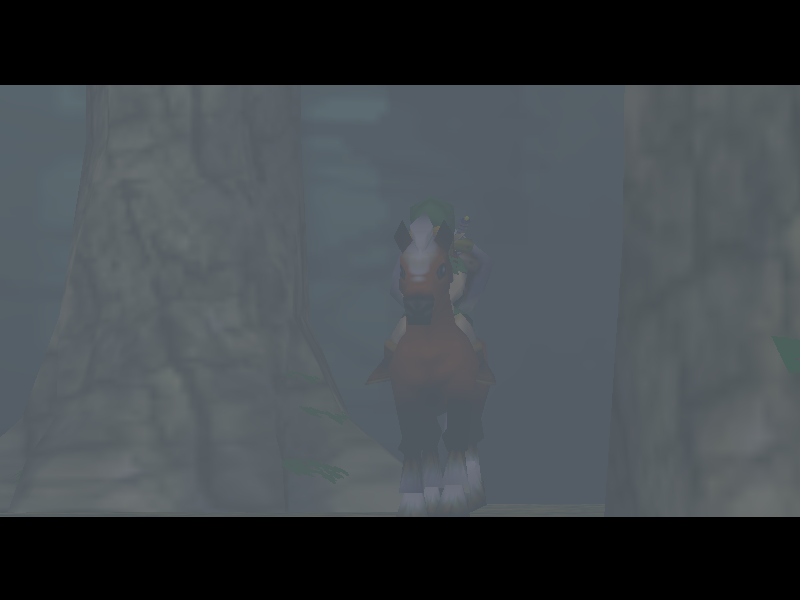
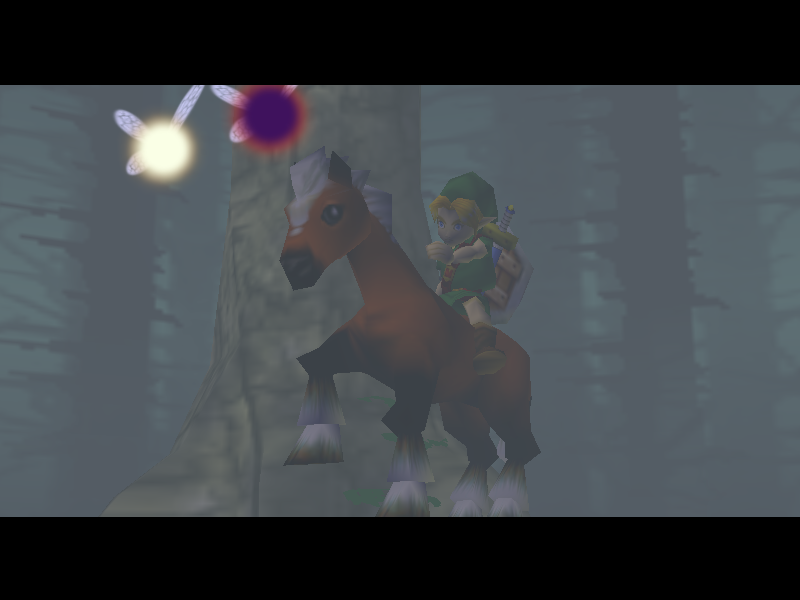
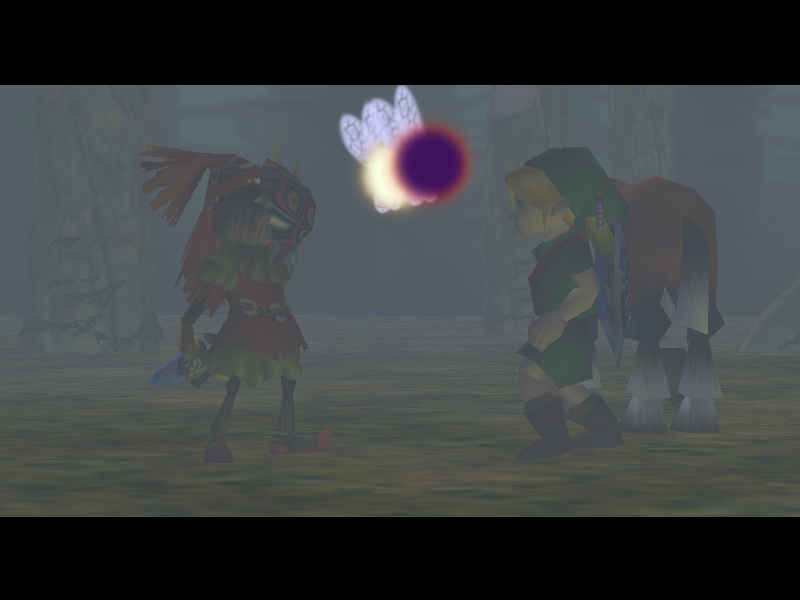
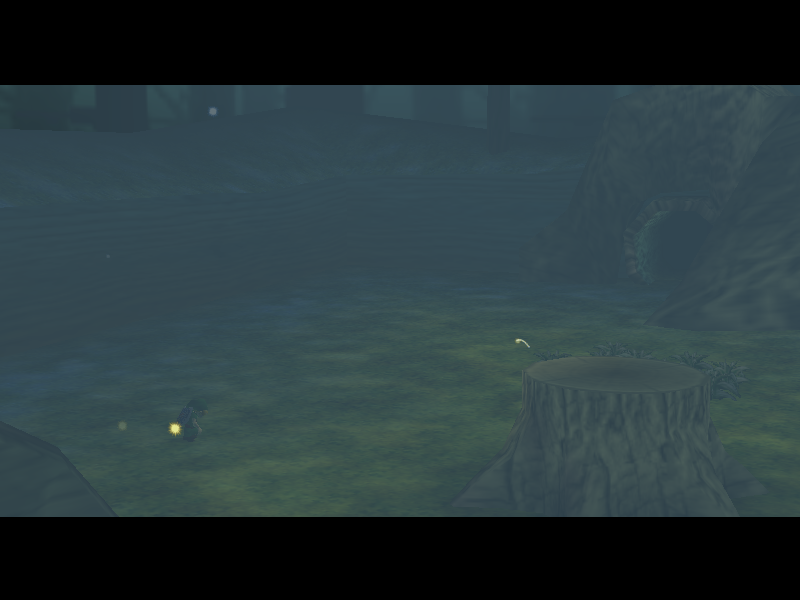
The story begins with our hero Link, once again back to being a little boy following his generation-spanning adventures in The Ocarina Of Time, wandering through a misty forest on the back of young Epona (his horse).
An instant later Epona is startled by two fairies and Link tumbles to the ground, knocking himself unconscious. Then before you can say "Oy that's my horse and Ocarina you git!" a masked figure pinches his Ocarina and jumps onto Epona. Despite a brave attempt at wrestling Epona from the masked figure's grasp Link eventually loses him and it's then that you take over. The next few sections of the game are very linear in nature with not a lot for you to really do. You basically get to do a bit of running around before you come to another cut-scene, then a little more running before another cut-scene kicks in... and so on. The culmination of all this is a sequence where Link faces off against the masked horse-thief and ends up getting turned into a Deku Scrub for his trouble!
This is where the game really begins in earnest. A quick trip through a few tunnels (one of which just happens to be a portal to another world) a brisk jog up some stairs, a chat with the mask seller from the first game and you're in town! This is where the difference between Zelda: Majora's Mask and the first Zelda game becomes apparent: this game has a serious time limit!
As soon as you enter the town square, a small gauge appears at the bottom of your screen. If you look upwards into the sky at this point you notice a big, angry-looking moon hovering above the town. In just three days time that rather large spaceborne lump of rock is going to crash into the planet! Of course... three days sounds like a long time, doesn't it? Except that three days game time roughly translates into about 45 minutes of real-time. As the gauge moves across the bottom of your screen all too quickly, you've got no time to lose if you don't want Link to end up in the N64 remake of Deep Impact!
First order of the day therefore is to recover the Ocarina, but of course there are plenty of other tasks for you to tackle first. The town in which you begin the game proper has plenty of places to visit and all manner of little tasks to perform. The most important thing for you when you first arrive is to secure yourself some weaponry because in three days time you need to confront the guy who stole your Ocarina and in his Deku Scrub form Link can't make use of his sword!
The answer to this puzzle is away with the fairies. As in the first game, if you explore your environment you eventually discover a fairy fountain and if you can persuade her to appear then the fairy bestows the power of spitting on little Deku Link which is an absolutely essential skill.
As in the first game, the days are divided into night and... erm, day. Depending on whether it's light or dark you run into different creatures in various places and at night-time the townsfolk pretty much stay indoors. This night and day puzzle element is even more important than in the first game because of the time limit. Unlike Ocarina Of Time, you can't just hang around waiting for it to get dark, because you've only got 72 hours before the untimely demise of the whole planet!
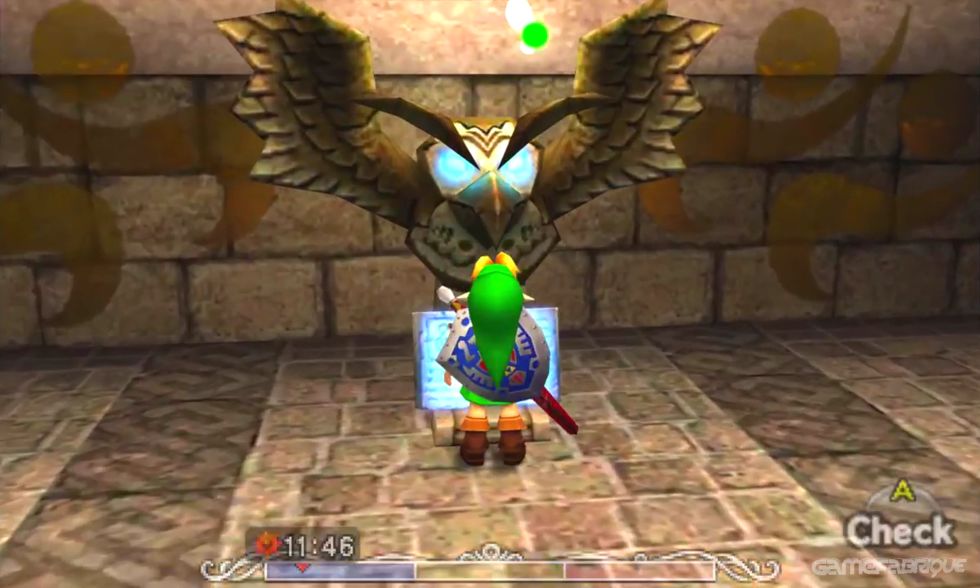
Assuming that you manage to obtain the abilities that you need to survive your confrontation with the masked man, you then get your Ocarina back and - using the Song of Time - can send yourself back to the start of the world, giving yourself another three days breathing space. But the clock just keeps on ticking! Needless to say, much of the game revolves around finding ways to gain yourself more time and to prevent the sun from rising on day four - fail just once and it's goodbye Link! Despite this pressing time limit there are still plenty of fun things to do and you should never find yourself getting overly stressed or bored.
Obviously, from the title of the game you've probably worked out that masks play a pretty big part in the whole adventure. In all there are a total of around 30 masks to collect in the game and they have a variety of different uses. Some of them act simply like ordinary masquerade masks, so that nothing special happens when Link puts them on - at least initially. Others however, are a little more unusual. For example there's the Deku Scrub mask, which Link gets when he manages to break the spell cast on him at the beginning of the game by the masked man. This mask and other similar ones like the Goron and Zora masks actually effect a physical change in Link when he puts them on. While wearing these masks our elven hero looks markedly different and takes on new abilities associated with the mask which are absolutely essential for making progress through the game. Essentially the masks replace the various tunics, shoes and weapons that Link collected in the first Zelda game. However, because the masks bring about an actual physical transformation it's a lot more fun. There's absolutely loads still to discover in this game - after about a week of solid play we've barely scratched the surface of the whole thing (although to be truthful we'd probably have got a bit further if the game was in English). Rest assured that with titles of this quality on the way you can put to rest the ridiculous rumour of the N64 being on the way out - if anything it's stronger than ever!
The sequel to the epic The Legend Of Zelda: The Ocarina Of Time has – you may not be surprised to learn – undergone yet another name change. Now titled as The Legend Of Zelda: Majora's Mask, the second game picks up from where the first left off and judging by what we've seen so far Link has got more than a few new tricks up his sleeve to dazzle all the Zelda fans out there. Unfortunately he may take a long time to get to your shelves, but for once this isn't because of any programming delay – you see Link has got a small problem: he's lost his horse!
The story of this forthcoming epic goes something along the lines of this... Link has just finished his time travelling adventure as related in the Ocarina of Time and quite understandably has decided to take a little breather from fighting evil. You begin the game as Kokiri kid Link is strolling through the forest, when all of a sudden a strange man in a mask steals the young horse Epona and disappears into a handy portal. Obviously Link's Famous Five-esque adventurer qualities take over at this point and he jumps through the portal in pursuit of the mysterious masked one.
Through the portal Link finds himself trapped in an alternate version of the land of Hyrule and it turns out that his missing horse is the least of his worries, because scant miles above the planet a moon is slowly falling out of orbit towards the land of Link's birth – when it rains in a hero's life it most definitely pours! This means it's up to you to save the planet, rescue your horse, defeat new enemies and confront the mysterious masked man.
Now not everything in this game is totally alien to the first, because if you glance over these screenshots you'll recognise some familiar faces from the first game. Expect to bump into Zelda, Malon and an alternate version of Navi along the way! The things that make this game different however are the masks. Where as in Ocarina Of Time you needed to have certain items to progress through the game, you now need certain masks. Find and slap on one of the 20 masks in the game and your entire character becomes transformed into something a little different to say the least! Put on the Goron mask for example and Link becomes one of the durable rock creatures, retaining only his little green hat. When in Goron form Link has increased strength as well as the ability to roll up into a ball and shoot along the floor!
Other masks include the Deku Scrub mask that turns Link into the one of the flowery fiends and allows him to walk on water, and the Zora mask which allows our hero to move effortlessly underneath the water. What makes these masks even more interesting though is that with each mask you also get new musical instruments in addition to the Ocarina – the Goron for instance, gets a set of bongos!
This game is definitely looking like it could top the original N64 Zelda and no doubt it will have you all scratching your heads once more over the suitably devious puzzles! It may be a long walk for Link without his horse but it promises to be a fun trip!
Link returns in an epic adventure that crosses the boundaries of time and space! He's been knocked out, his Ocarina has been stolen, someone's nicked his horse and now the moon is about to crash into the planet... all in all, Link's not having a very good day! This is the premise behind the game that anyone with an ounce of enthusiasm for the Nintendo 64 has been waiting on ever since the first rumours sprang up that gaming master Shigeru Miyamoto had a sequel to Zelda: Ocarina Of Time up his sleeve. Well it's here, and it more than lives up to advance expectations!
"The Legend Of Zelda: Majora's Mask is fantastic. Bloody brilliant!"
If you've played the first N64 Zelda game then you'll know that it spans two different time-frames, beginning with Link (a heroic Elf) as a child in the healthy and happy land of Hyrule, and then shifting seven years into the future where Link's 'all grown up' and Hyrule is looking like one of the sets from a Mad Max movie (ie: somewhat post-Apocalyptic). Right at the end of the game though, once evil has been vanquished and everything in the land has been set to rights, the guardians of Hyrule that Link has helped to free, spin back time and send him back to Hyrule the way he left it... as a small boy.
And this is where Majora's Mask picks up the story. For hardly has little Link got back to the lush, green forest where he lives when he's mugged by a strange masked figure who runs off with his horse and his Ocarina. Link though – being the heroic type that he is – gives chase, and he pursues the masked thief into a strange portal in a tree which just so happens to lead to the mysterious land of Termina.
It's Time... For Time!
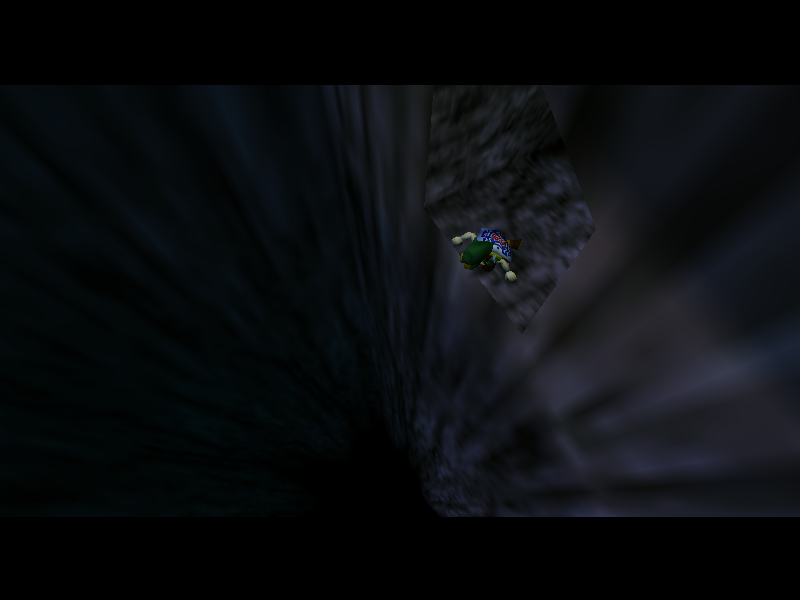
Of course, being a Zelda game, this is no ordinary portal, and Link hasn't just popped across the border into a different county, oh no. It appears that Termina is in another dimension and Link's arrived at a bit of a bad time, because a rather angry-looking moon is about to crash into the planet – in just three days! As if all this wasn't bad enough, the masked thief intercepts Link just after he passes through the portal and – without so much as a "by your leave" – turns him into a Deku Scrub! It's here that you assume control of Link and the adventure really begins. For a travelling mask-seller announces that he has a way of turning Link back to normal, but first our Elven hero must get back an object that has been stolen – by none other than the horse and Ocarina thief himself!
The Missing Link?
The first thing that really strikes you about Majora's Mask (aside from the fact that the central character is initially a short and stumpy plant as opposed to a small boy with pointed ears) is the time limit. This is represented by a small sundial at the bottom of the screen, upon which a Sun (or – at night – a moon) moves round with fairly alarming speed. You've got just three days to find the thief and get your stuff back, or it's 'game over' for everyone! The result is a fairly hectic first hour of play or so, as you try and talk to everyone and visit everywhere at once in your desperate search for clues. All the while the clock keeps ticking down and before you know it it's the third day and you realise that there's no way you're going to explore even a fraction of the game before the time limit expires... so what do you do?
"Don't hesitate to buy this game!"
Well, luckily things aren't as bad as they seem. The people you meet, and the fairy that you pick up when you enter the portal give you a variety of handy clues, and in fact by the end of the third day, you only have to have completed a few specific tasks which lead to you doing one thing – getting your Ocarina back. Now we're not saying that this is easy by any means, and in fact the chances are that the first time out your efforts will be rewarded with a dramatic sequence of the moon smashing into the planet and killing everyone in Termina. However if you pay attention to the clues and remember what you did each time, then you'll get there in the end. It is actually just about possible to accomplish pretty much all of the tasks that you need to do to get your hands on the Ocarina within the first 12 hours of the first day – once you know what you're doing.
Play That Funky Music...
Anyway, once you get the Ocarina (and we're not going to tell you how to, although obviously you've got a guide now if you do get stuck) you get to experience a brief flashback sequence in which Link's old sweetheart Princess Zelda teaches him the Song Of Time... a blatant clue if ever there were one that you should play the tune – now! A quick blast on the Ocarina later, and Link finds himself at the beginning of the first morning, having moved back three days in time! And it's now that the game really begins in earnest.
By using the Ocarina, Link can transport himself back to the first day whenever he chooses. He can also jump forwards in 12-hour leaps and can slow time down too, in order to give himself plenty of time to explore the land of Termina and solve the all-important puzzles. The catch is that whenever Link leaps back in time, everything resets... or almost everything. Link loses any cash he happens to be carrying, any characters he has met over the three days will act as if they have never met him (because they haven't, see?) and any tasks he was in the process of completing reset. However, it's not all bad. Any special objects Link has found such as the masks (which we'll come to in a minute), the Ocarina, the various weapons and things like the extra heart pieces are all retained, so he's not left with a totally blank slate.
Through careful manipulation of time therefore, Link must explore the lands of Termina, conquer the dungeons and ultimately defeat the mask thief, who turns out to be a lot more troublesome than he seemed at first! And the key to everything is those pesky masks.
A Stitch In Time...
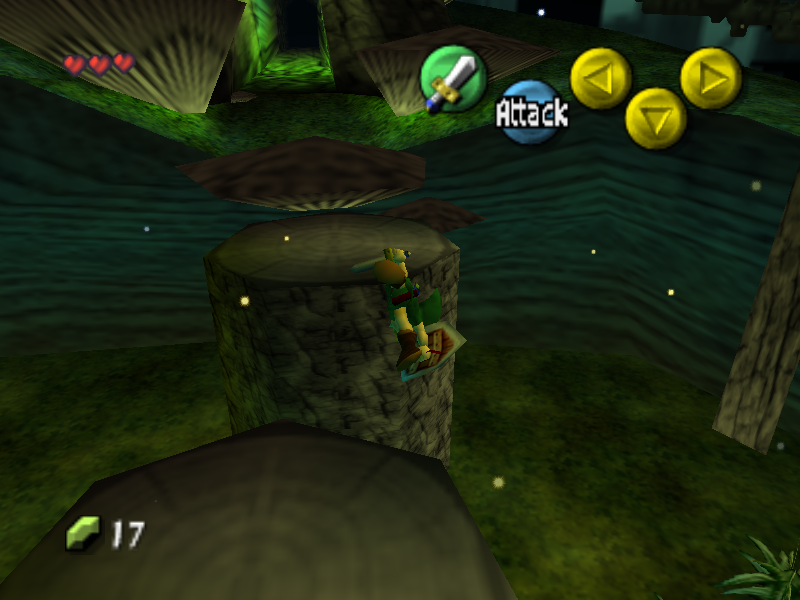
There are 24 masks in all, and although he doesn't know it when he starts out, Link's already got one! You see, return to the mask-seller with the Ocarina and he reverses the mask thief's spell, turning Link back into a boy... a boy with a Deku Scrub mask. Link can now put this mask on and take it off at will, and whenever he puts on the mask, he takes on the special abilities of the Deku Scrub, allowing him to blow bubbles and fly to a limited degree (no more hang-gliding with chickens in this game, oh no!)
All the masks in the game have different properties. Some transform Link and give him special abilities like the Deku Scrub mask, some enhance his normal abilities, some allow him to communicate with certain characters... each of them has a specific use. You don't need all the masks to complete the game, but they all do something.
Like in the first Zelda game, in Majora's Mask the gameplay is linear... and it's not. That is to say, there are certain tasks which you must perform, certain places you must go and certain things you have to find in order to progress through the adventure. But at the same time, there are absolutely loads of things that you can do in different locations more or less whenever you feel like it. Some of these things grant you special items (like the masks) and these may or may not help you in the rest of the adventure, but some of the activities are fairly irrelevant and only result in extra cash or energy... plus a generous helping of fun, of course!
Time Is On Your Side
Now that's enough about what's in the game for the moment. The important question – the most important question in fact – is this... is it any good? No, hang on, that's a stupid question. You've played Ocarina Of Time, right? Let's face it, it'd be a bit bloody difficult to take that masterpiece and then make another game based on the same engine that was rubbish, wouldn't it? Well, wouldn't it? You know it would, and so to put all of you out there who are wondering "when's he gonna say if it's any good?" out of your misery... The Legend Of Zelda: Majora's Mask is fantastic. Bloody brilliant. If you've got the cash, you want a game and you're after the adventure of a lifetime (without leaving the comfort of your armchair of course) then don't hesitate to buy this game. You won't regret it. There... that's sorted that out. Now that we're all reassured, let's move along, because while Majora's Mask IS a fantastic game, it's NOT a perfect game. (Pause for shocked silence). Interested as to why? Then read on...
Bad Moon Falling...
The Legend Of Zelda: Majora's Mask has an awful lot going for it. On the face of it, you might say that it's very difficult to criticise it, because there are so many things to praise, and that's actually pretty damn true! Even the time-limit – which at first looks like being a complete downer – isn't too bad once Link's managed to get his sweaty little Elf hands on the Ocarina, and in fact once you've safely accomplished this, you begin to appreciate the initial time limit as a way of creating a nice degree of tension – in what might otherwise be a rather slow start to the game while you'd be finding your feet and trying to figure out exactly where to go.
"The storyline to Majora's Mask is far superior to that of the first game..."
Lots of things from the first game seem to have been looked at and either done away with or altered to make them a little more gamer-friendly. Good examples of this are the gold Skulltulas from Ocarina Of Time. Remember them? You had to find all of them (although it wasn't essential to completing the game) only the catch was that they were scattered all over Hyrule and some of them only came out at night – with the result that you'd find yourself plodding through numerous locations in both light and dark because you couldn't be sure that you hadn't missed one of the pesky spider-like things.
Enter the log book. While there aren't any gold Skulltulas this time around (although you get to meet some of their non-gold bigger brothers) there are however a number of different tasks that can only be accomplished at specific times. This might mean a character is only in a certain location for a few hours on the night of the second day for example, or perhaps a door is only accessible during the morning of the first day – that sort of thing. The log book is the key to all this. Once you've found it (you do have to find it first – wouldn't do to make things too easy) the log book gives you details and clues as to who you still need to talk to or interact with – and when – and this is extremely handy when you're stuck for what to do next.
"This is still an absolutely megatastic game!"
Man In The Ironic Mask
Graphically, this game is very similar to the first (but then we'd expect that, as it's using the same engine) only perhaps a little more polished. But then, since the first game looked fantastic, you can hardly complain. What you can complain about though is the game camera. Now we might be remembering a little unclearly here, but we're fairly sure that there weren't too many problems with the visual angles in the first game. With Majora's Mask however, the camera can be – to put it mildly – a complete bastard at times. It's not always the case, by any means, but it does seem – particularly in the dungeon sections – that the camera doesn't always present you with the most useful view that perhaps it could. This may well be due to the restrictions imposed by the dimensions of the various rooms, but it nevertheless doesn't help matters and the camera movement doesn't seem to be as intuitive as you would expect.
Still... Got Your Elf!
Controls-wise, though, Majora's Mask is second to none. The same system of assigning various weapons and objects to the C Buttons is employed here as in the original, and Link responds extremely well to every button press. Most impressive though is the way that the game doesn't expect you to rely on the controls for any stupidly tricky maneuvers, which could become very frustrating. Anyone who tried climbing up the huge tree during the Summer season in Banjo-Kazooie for instance will know that it was incredibly difficult to accomplish – as a result of the controls and the design of the tree – and thus it spoiled the enjoyment of the game somewhat. Because Link leaps automatically however, the annoying problem of timing 3D jumps doesn't crop up and the chances are that any situation which appears to require Astronaut-level dexterity to accomplish actually has a rather more simple solution – if only you'd think about it for a bit. Trying to reach Snowhead Mountain on a narrow path in the teeth of a raging gale is a good example of this...
Gorgeous Gameplay Unmasked!
So overall, improvements seem to have been made. The time limit can be annoying at times, because even though you control time, the fact that tasks reset when you travel back can mean that you get almost all the way through a dungeon, only to run out of time, have to return to day one, and thus end up having to do the dungeon all over again. Which can be a bit of a pain. And another thing which might disappoint some Zelda fans is the size of the game. Say what you want about this one... it's just not as big as Legend of Zelda: Ocarina Of Time.
That said, the storyline to Majora's Mask is far superior to that of the first game and besides the camera and the occasional annoyance created by the advance of time, the puzzles, quests, objects and characters that you meet in this game make it a more than worthy sequel. The thing is... it's just not really much better than the first game! This isn't through any fault of its own, it's just because the first game was so absolutely stonkingly brilliant that it would take something almost God-like to top it, and while this game is superb, it isn't quite that. Don't get us wrong: this is still an absolutely megatastic game – hence we've awarded it a Gold Medal – but if you're expecting something stupendously different from the first title, then you're not really going to get it. That's NOT a bad thing, by any means, it's just a fact. Of course, having seen two Zelda games of this quality, just think what Link's adventures on the Gamecube are going to be like...
Nintendo recently released new shots this one, so an update is in order. In this sequel, Link finds himself in an alternate dimension where a rather evil Moon is on its way down--its crash will destroy the world and everything on it. You have three days to stop this from happening. Link can turn into new characters with interesting powers and abilities via magical masks. Majora's Mask should be available in the fall.
One sequel that everyone's been dying to see is an update to Zelda. Well, here it is. Legend of Zelda 64 is an adventure that uses polygon characters to bring the realm of Hyrule alive. This game was extremely early, but if these shots are real-time and not cinemas, the game will be awesome. In any case, Legend of Zelda 64 looks impressive. There are a few cool visual effects like sparks that fly when Link hits an enemy with his sword.

The storyline is still up in the air as Nintendo's not talking. However, whatever they have up their sleeve, you can bet that it'll generate the same excitement as the original game.
Nintendo's premier RPG, which first appeared for the NES, is readying itself for battle on the U64. Still in its early stages, this game has sparked a great deal of controversy and anticipation over what it is expected to deliver to players. So far, we are assuming that the characters are all polygon-based, and the fighting sequences will zoom in and take place in a 3-D battlefield. This game will be coming out at the same time as Nintendo's "bulky drive" (December 1996). It probably will be the first disc game for the system!
The game you've been waiting for your whole life here at last!
How would you spend ?14 million? You could buy a private jet, a huge yacht, a fleet of Ferraris, a diamond the size of Chris Evans' ego. Or, as Nintendo did, you could use it to create the greatest videogame ever. Your choice.
Before we start, it's worth pointing out that this is not a typical review. The conditions under which we played the game were less than ideal; your editor had to travel to Nintendo of Europe's headquarters in Assendoneinvhere, Germany, to discover that not only was there only one computer capable of taking screenshots in the entire building, but it also had to be shared between 14 journalists from all around Europe, and didn't even become available until the afternoon of the flight back. On top of that, Nintendo was decidedly paranoid about the game, resulting in the laughable spectacle of various hacks being escorted around the Nintendo building by German officials with N64's under their arms, the Zelda cartridges padlocked firmly into place by some dastardly apparatus from the Marquis de Sade's bedchamber. As one of the other Brits commented, "You wouldn't get this at Sony."
The weird thing? It was all worth it.
Play That Funky Musk, Elf Boy
People have been waiting a very long time indeed to play The Legend Of Zelda: The Ocarina Of Time. After that kind of build-up, very few games are actually able to meet everyone's expectations. Case in point, this very issue; Turok 2. It's good, but it's not quite the knockout that people had anticipated.
Zelda, on the other hand, not only meets every expectation you had of it, but actually exceeds them. When it comes to what people will now demand of a top videogame, Nintendo has moved the goalposts off the pitch, into a lorry, down the road, into the airport, onto a plane and halfway round the world to a different continent entirely.
There isn't a single square inch of the vast game world that hasn't been subjected to intense scrutiny by Nintendo's designers, programmers and testers, and then polished to a finish so glossy it makes Dulux jealous. Zelda has the perfect learning curve, which makes what is actually quite a complex control system as second-nature as breathing by the time players leave the safety of the forest where they start and head into the wide world beyond. Link begins the game as a child with a couple of basic skills and the clothes on his back. In the process of exploring his home, Kokiri Village, he picks up the essentials of adventuring.
As the game begins, Link (who can be renamed if you want) is summoned by Navi the fairy, who from then on becomes his constant companion, to see the Deku Tree. This big old stick is the guardian of Link's village, but his roots have recently been infested with evil creatures. He also knows that Link's been having nightmares about a malevolent force taking over the world - realising that it could be a prophecy, the Deku Tree decides that Link is the key to preventing a catastrophe. Once the Deku Tree has been fumigated, Link has to set out into the world of Hyrule to find the young girl glimpsed in his nightmares... Princess Zelda.

As Long As You've Got Your Elf
If you've played any of the previous Zelda games, there are many things about the N64 game that will feel familiar - places, people, being able to pick up chickens and hurl them around like feathered beachballs. If you haven't played one of the older games, there's no need to worry - the Tolkien-style world is a fantasy archetype, and after a couple of minutes you'll feel right at home.
On the surface, Zelda might look similar to Mario 64 or Banjo-Kazooie, in that you control a character who can roam freely through a 3-D world. If you're expecting a platform game, though, you're in for a shock.
While there are places where Link has to leap from ledges and climb up cliffs, the game engine is smart enough to perform these actions automatically when needed. What, no jump button? Run Link at the edge of a raised area and he'll jump, move him to a ladder and he'll climb, send him into water and he'll swim. Taking these actions out of the hands of the player may seem as though control is being surrendered, but it isn't. Only donkey work is being given up - more specific actions are still entirely up to you.
The key to all this is the incredibly clever control system. The A button is the 'action' command, which depending on circumstances lets Link open doors, talk to people, enter small spaces, climb walls, push objects, uproot plants, attack enemies, jump in battle... the list goes on. You only have to glance at the icon at the top of the screen to see what Link can do at any given moment.
The B button controls Link's main weapon - by using this in conjunction with the analogue stick, he can make different kinds of attack - and R brings up his shield. The ingenious part of the combat system is the use of the Z trigger as well. By holding Z while attacking. Link locks onto an enemy and will always face it, even while moving around. The combination of these three buttons gives players what is quite simply the best combat system ever. Until you've used it in action it's hard to appreciate just how good it is, but Link can dodge, feint, probe for weaknesses, defend and dart in for devastating effect against multiple opponents, without the action ever becoming confusing.
Even the inventory system is ingenious, with no need to keep stopping the game to switch between items. Using the objects that Link collects is simplicity itself. On the Select Item subscreen, move the cursor over an item, push whichever C button you want to assign it to, and that's it. Back in the game, every time you push that C button the item will be used, be it a weapon, a magical spell or a fish in a bottle.
Icon See Clearly Now
Once Link gets out into the big wide world, the game becomes a mixture of combat, exploration, character interaction and puzzles. Hyrule is vast, but is laid out in such a way that players don't have to spend hours slogging back and forth between areas. It's usually made clear where Link needs to go next, and if you forget, the in-game map helpfully puts up flashing icons to show places of importance. Later in the game, shortcuts become available to cut down still further on travelling time.
A few people have been heard to complain about Zelda's lack of support for the Expansion Pak. You know something? It doesn't need it. The game looks gorgeous enough as it is; it's hard to see how banging in a few extra pixels on screen could improve matters. Watching the sun set over Hyrule Castle, battling against the massive bosses, seeing the lengthy expository cut-scenes unfold or just sitting down to go fishing... everything looks superb.
Zelda, unlike most games, goes to great pains to give its characters... well, character. Minor actors are given typically Nintendo exaggerated facial characteristics to make them stick in the memory (the Quasimodo-like gravedigger. Talon the bog-eyed, sinister-'tached farmhand with ideas above his station) and major characters like Zelda, Seria, Ganondorf and Link himself have facial expressions that perfectly emote their feelings. The characterisation helps pull you into the story in a way no videogame has managed before.

There are also plenty of delightful comedy moments that help provide relief from the main story. From Navi banging head-on into a fence in an opening scene, to Goron disco dancing, to fun with chickens, even the most cynical will crack a smile.
The closest comparable game to Zelda would be Final Fantasy VII on the PlayStation. But that's not really a fair comparison, because Zelda hammers FFVII into the ground on every level.
Because Zelda never takes you out of the game world, unlike FFVII constant stop-start turn-based attacks and CD access, Nintendo's game completely immerses you in the story and gets you involved with what happens to the characters. You might sniffle a bit when Aeris buys the farm in FFVII (oops, did that spoil it for you?) but Link's adventures are so absorbing that even your dreams will revolve around saving Hyrule. I speak from experience.
Never Mind The Blocks
Like most adventure games (apart from Holy Magic Century, which took the brave step of not bothering with all that tedious discovering stuff in favour of hour after hour after hour of random monster attacks) Zelda has loads of puzzles and problems that have to be solved before Link can progress. Some of them are straightforward enough -anyone who's ever played Tomb Raider will feel right at home with the sliding block sections. Other parts require more imagination to solve. Some of the puzzles seem impossible to work out at first, until with a mighty slap of the head and a cry of "Duh!" you suddenly realise what has to be done. If you remember that all the necessary clues and items are available by the time you reach a puzzle, and that for the most part things behave as they do in the real world, you'll get there in the end.
If you ever get stuck, then it's almost certainly your fault for not exploring the vicinity properly. In the whole intensive 22-odd hours play at Nintendo HQ, there was only one time - quite near the start of the game - when Link had to go back to an earlier point to get something he'd missed in order to solve a puzzle. The rest of the time, when you reach a problem, the means of solving it is either a short distance away or already in your grasp - you just have to work out how to use it. Just as a hint to new players, which won't spoil the game at all, once you've been given the ocarina it's worth going back and finding the person who gave it to you again before you begin the main adventure. It'll save you a walk later on!
I'm Huge!
Just how big a game is Zelda? In the course of two days at Nintendo of Europe's headquarters, 64 Magazine put in about 22 hours of play. To put this in perspective, it took 12 hours to complete just the first, relatively straightforward part of the adventure, at the end of which Link winds up seven years older. According to Nintendo, a player who has already completed the game, knows where everything is and how to defeat all the enemies, would take about 40 hours to reach the finish. And that's only 70% of the game! As well as the main quest to save Hyrule, there are all kinds of smaller missions, challenges and amusing subgames to do on the side.
Some readers gave us stick for saying Banjo-Kazooie was challenging when they finished it in no time. Well, apart from saying that these people should get out more, we can confidently say that it will be quite a while before Zelda gives up all its secrets. Remember, you need to eat and sleep and stuff like that.
Obviously it wouldn't be a proper 64 Magazine review without finding some things to complain about, so here goes; once you've figured out the pattern of a boss's attack you can always beat them without harm; you can't speed up text, only skip it; the targeting system occasionally takes a few tries to lock on; narrow corridors put the camera too close behind Link for comfort; the chirpy music drills into your head like a Cerebral Bore and won't leave. As far as things wrong with the game go, that's pretty much it. You'll live with them.
If you have an N64, buy this game. If you don't have an N64, buy one, then buy this game. That's how good it is. Nintendo's problem now is that they've created a game that's so good, it's hard to see how they can top it. But then, people said that about Super Mario 64, and compared to Zelda, Mario is just a demo knocked up in someone's spare time. Even Goldeneye looks a bit anaemic alongside Zelda.
With less than 13 months to go, it's a fairly safe bet that nothing more stunning is going to come along before the turn of the millennium. Even if you're one of those smart-arses who witters on about the millennium not really starting until 2001 it still applies. If you don't buy Zelda 64, you're missing out on the game of the century.
Shiggsy Speaks!
We flew all the way to Japan to interview Zelda creator Shigeru Miyamoto in his secret underground train that whisks him around Japan. No we didn't. We got this from the press release like everyone else. But it's still interesting stuff...
So, Shiggsy; what do you think is the secret of a great game? Well, I think the most important factor is the correct mixture, ie the weighing of the different elements of a game. My successful principle bases on a 70 to 30 percent share, that is to say 70 percent of tasks to be performed and the remaining 30 percent of secrets and mysteries to be unveiled and solved by the player.
How does Zelda 64 compare to Mario 64? In the creation of Super Mario 64, I was actually the director of the game, this time I am the producer. In Zelda 64, there are actually four directors, responsible for different fields of the game.
How many people were cracking away on Zelda? About 40-50 persons, the biggest development team ever involved in the creation of a game! Additionally, we closely co-operated with another company to perfect the programming of the adventure. If we add this group to our own team, I can say that about 120 persons were involved.
How big's this sucker, then? This is a difficult question to answer, for the playing time depends on each player and on his individual skills. Its scope is at least comparable with The Legend Of Zelda: A Link To The Past SNES but the player now has many more possibilities to move around freely and explore even distant places on the world's surface. I think that it will take a versed player at least 40 hours of gaming to finish the adventure.
Cheers, Shiggsy. Next time you're in Bournemouth, drop by the Jug of Ale for a pint!
A long with Perfect Dark, Zelda Gaiden is the game to put 40 aside for next year - and these extra ordinary new shots further prove the wonder of Nintendo's newer.
With Miyamoto casting an eager eye over proceedings, the design team responsible for the magnificent Ocarina of Time are rapidly turning Link's second N64 adventure into - astonishingly - something even better. With 4Mb of extra oooomph thanks to the expansion paê, Caiden now boasts a wondrous level of detail - the environments are absoflippin'-lutely amazing - as well as the ability to throw around enemies at a rate of knots Acclaim-Austin can only dream of. During a brief spell in one of the game's unnamed Dungeons, for example, up to seven Stalfos skeletons attacked us at one time, when compared to Ocarina of Time, which could only face off two at a time, it's a bum-trembling achievement.

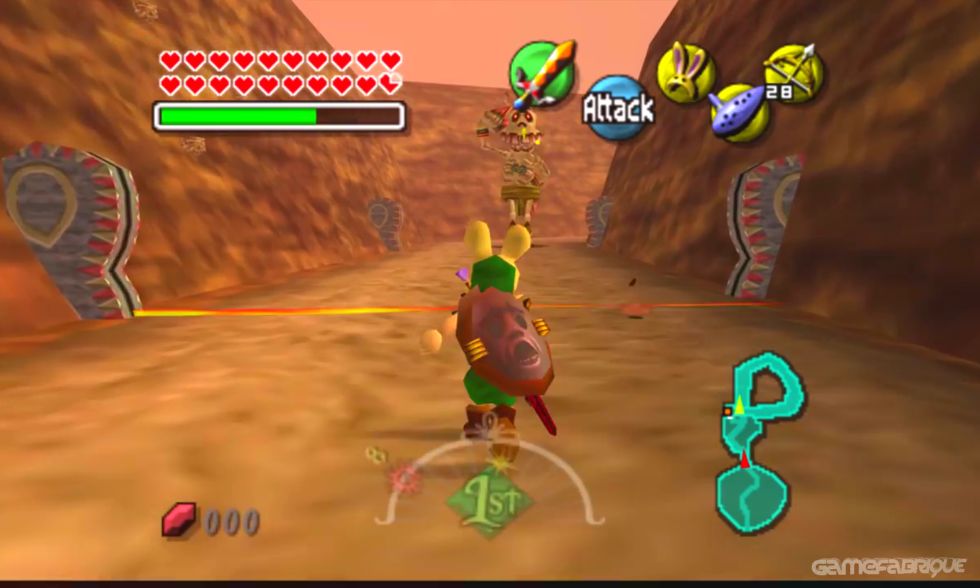
But, more significant is the game's emphasis on masks this time round, and Link's ability to use them to gain the skills and abilities of those they belong to. Coron, Zora, a Deku Scrub, each of these Link can change into, with some truly terrifying transformation scenes as accompaniment. Look out for more on this breathtaking Nintendo game in coming months...
If you thought Mario64 was impressive - you ain't seen nothing yet!
Zelda. The name commands respect because on the Super NES it was a multi-layered adventure game of such maturity and depth, that many gamers were left with the impression that the ultimate game had arrived - nothing could touch it. So it is with great anticipation that we N64 adoptees await the coming of Zelda 64 - all the lush plots and characterisation of the original, but now with added 'zing.'
Originally pencilled in as the N64's first 64DD game (see the technical explanation of the machine at the front of this magazine). Zelda 64 is now rumoured to be coming on a cartridge, although how the incredible world it promises is to be run from the base storage system is still a mystery.
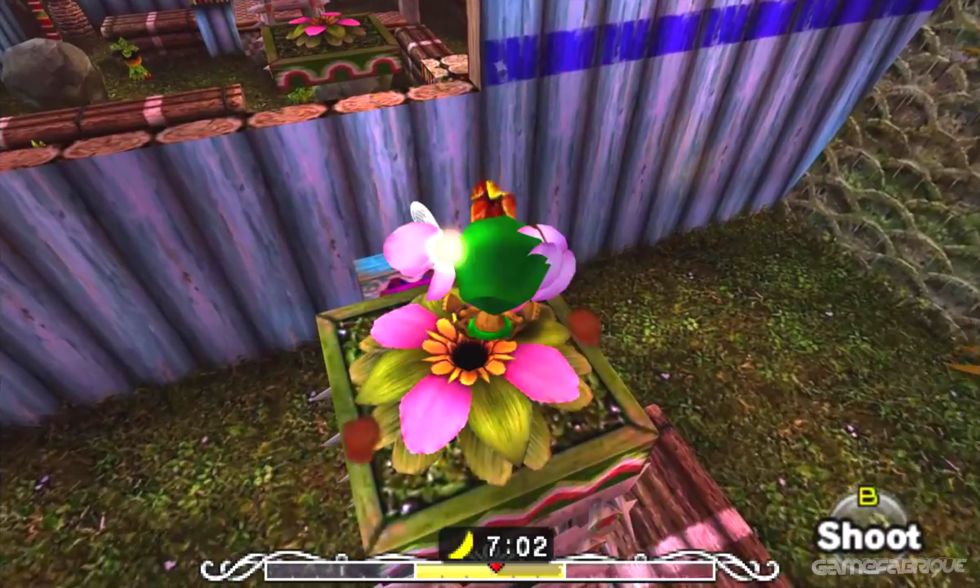
As in Legend of Zelda on the Super NES, you play Link, but you're a slightly older version of the wide-eyed kid who appeared in 1993/4. The game is a graphical adventure, with you controlling Link very much like Mario, but the main difference is that you can interact with all the non-player
characters in the game, as well as collecting new weapons, armour and magical items. Zelda 64 is also not a level-based game. You get the whole world to explore, arid if there's an area which is blocked off, you must first solve a puzzle elsewhere to access it. The original game was viewed almost from directly above and battles merely consisted of you slashing away at sprites until they expired. What Zelda 64 brings to the series is full 3-D battles, very much like Tekken 2 on the PlayStation, and instead of having a fixed viewpoint, you can change the camera angle at any time. Link must collect rupees (cash) on his quest, as well as hearts (lifeforce) and as in the original, special hidden hearts can be found which extend your overall health rating. You will also have an inventory to store precious items, and as you kill more enemies and open up the game, your weapons and skills will gradually increase, allowing you to perform even more outrageous moves.
Zelda 64 will be THE game to have on the new console. Mario was impressive, but this is completely AMAZING. Start saving, pester games shops, don't take no for an answer. When Zelda 64 arrives you will not leave the house for a month. Look forward to an in-depth report in the next issue of 64 Magazine.

Prospects: The Jurassic Park or videogames, zelda will be bought by everyone and show just what 64-bit power can do.
The main question up until now with every new Zelda game has never been "is it good?"--they all have been, even the Game Boy version. Instead it's "how good is it?" Luckily with Majora's Mask the question is once again valid, and the answer, "Abso-frickin'-lutely incredible," is once again the same. Majora's Mask is not really a new take on Zelda--most everything from the controls (Z-targeting, auto jumping) to the items (fire arrows, the Lens ofTruth, Hookshot) to even the characters return from the last N64 Zelda, Ocarina of Time. Graphically you might even mistake them for the same game, although Majora's Mask seems to use the required RAM Expansion Pak for a few larger open areas.
But similar to how the Super Nintendo version of Zelda improved on the original NES title, this new N64 edition doesn't totally rethink the game, but rather refines and polishes the gameplay using the same overall shell. The biggest gameplay change is the fact that, for most of the game, you don't play as Link. You play as Goron Link, Deku Link or Zora Link-transformations with all new powers whose identity Link assumes when he wears certain masks. The beauty of Majora's Mask is how it uses the different advantages, disadvantages and special abilities of each of these forms; they are seamlessly woven into every part of the game, from secrets scattered throughout the overworld, to all the people you interact with, to the ingenious dungeon puzzles.
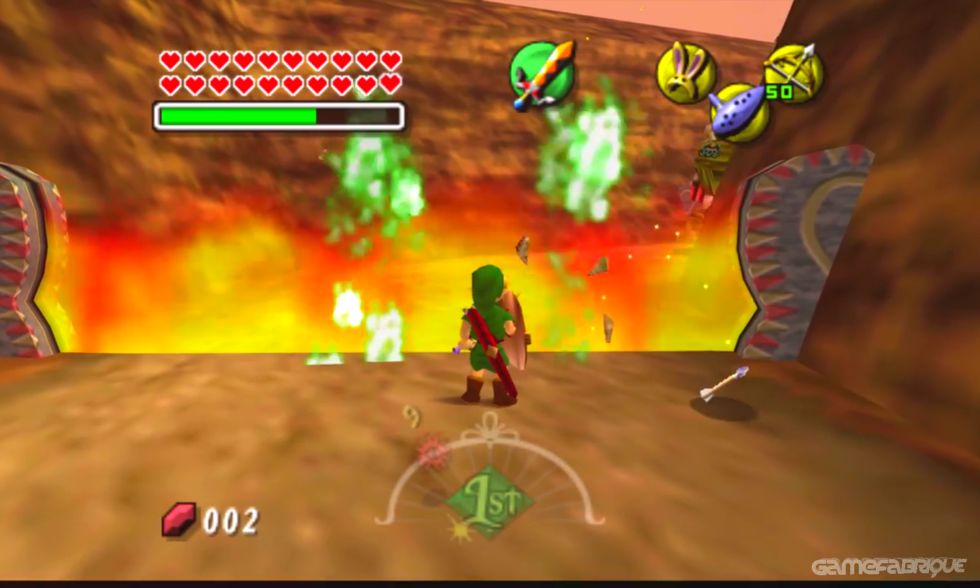
The other inspired difference is the new importance of time: Taking place over three repeating days, what time it is in Majora's Mask becomes as important as where you are (and sometimes, who you are) in figuring out many of the game's devilish puzzles and subquests. Even if you are one of the lucky few to find a PS2 on launch day, you won't find a better game for any system in the stores this Oct. 26.
People say:
I still think Ocarina of Time is one of the best games ever made, so it's no small thing when I say Majora's Mask is even better. The "Wow" factor of being in a 3D real-time Zelda game for the first time is gone, but the thrill of exploration is still there and the controls and actual gameplay are stronger than ever. Swimming with Zora link, rolling around with Goron Link, and flying with Deku Link make getting from place to place a lot easier and more enjoyable this time around. Plus there are thankfully now plenty of warp points, with a single Ocarina song to fly instantly between them. As with OoT, the game isn't totally linear either; you can choose to continue down the road toward your ultimate objective, or take a side journey through any of the insane amount of minigames or side-quests. The dungeon designs are works of art, each totally different except for the fact that they all incorporate the items and different forms you can assume seamlessly. Filled with all sorts of tricks and traps, they are like intricate puzzles themselves--only with persistence and real thought will you figure them out. The save system is a big improvement over the Japanese version, too. It doesn't make the game any easier, but lets you turn your N64 off when you need to. Everything else is done right: the memorable characters (old and new), the funny subplots, the added emphasis on time, the bosses, the mini-games. Incredible.
I love the time-travel aspect in Majora's Mask, even moreso than Ocarina of Time in some ways. Technically this game only lasts three (game) days, but with the use of the ocarina you get to replay those days over and over again. Kinda like Zelda meets Groundhog Day. Besides the novel approach, what you really get in Majora's Mask is more of the same great gameplay from the last game, complete with an entirely new, though eerily familiar, world to explore and a unique set of quests and mini-games. It's too bad the N64 is aging so poorly. The fuzzy graphics really hurt this game in my opinion. Not enough to mess with the score, though.
Playing Ocarina of Time was such a wonderful experience I was utterly convinced nothing would be able to top it for many, many years. OK, I was wrong, but at least it was another Zetda game that smashed my prediction, so I don't feel as bad. The reason I love Majora's Mask so much is because it isn't just an extension of the last Zelda; it's much more than a set of new dungeons. Aside from the three-day time limit (which is very cool, by the way), and the keen visual upgrades, a new gameplay focus--how most of the challenges lie in the lands around the dungeons instead of just inside them--gives Mask a unique feel from OoT, but one that's no less magical.
Nintendo has had a great history with the Zelda series of games and it was always presumed that a 64-bit version would appear around the same time as the new machine.This one looks like it might be a little late however, since Nintendo plans to release it at the same time as its top-secret Ultra 64 device, currently known as the Bulky Storage Device.
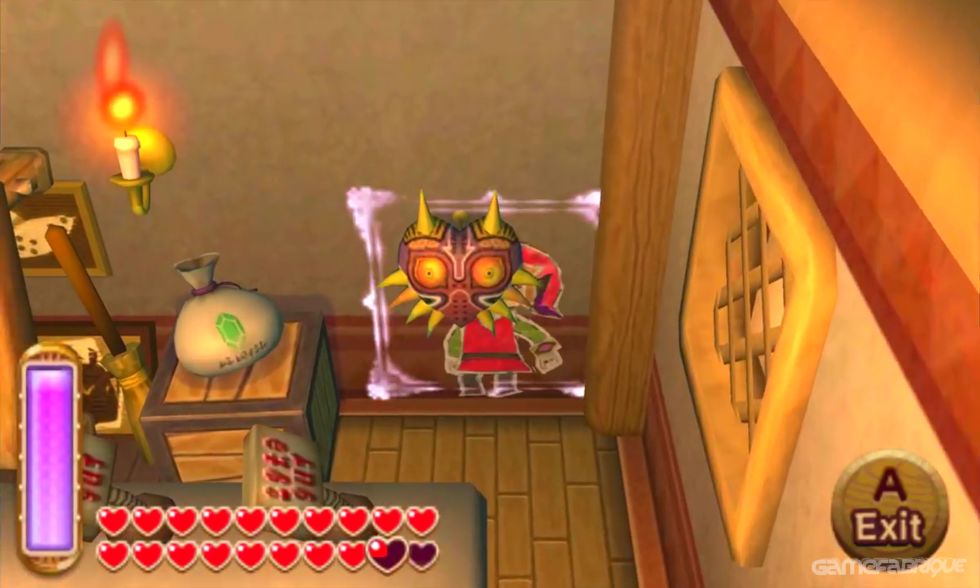
Not much is known at present with regards to how Zelda will play, but similar puzzles and an all-new 3-D environment are definite inclusions. The character animation is incredible.
Snapshots and Media
Nintendo 64/N64 Screenshots





Similar Games
 A Bug's Life
 Buck Bumble
 Donkey Kong 64
 GEX 3: Deep Cover Gecko
 Jade Cocoon
Все игры Зельда
 The Legend of Zelda: Ancient Stone Tablets
 The Legend of Zelda: Skyward Sword HD
 The Legend of Zelda: Ocarina of Time 3D
 The Legend of Zelda: A Link Between Worlds
 The Legend of Zelda: Oracle of Ages
 The Legend of Zelda: Ocarina of Time: Master Quest
 Cadence of Hyrule
 The Legend of Zelda: Link's Awakening
 Legend of Zelda: Ocarina of Time 3D
 The Legend of Zelda: Breath of the Wild 2
 The Legend of Zelda: The Minish Cap
 Zelda II: The Adventure of Link